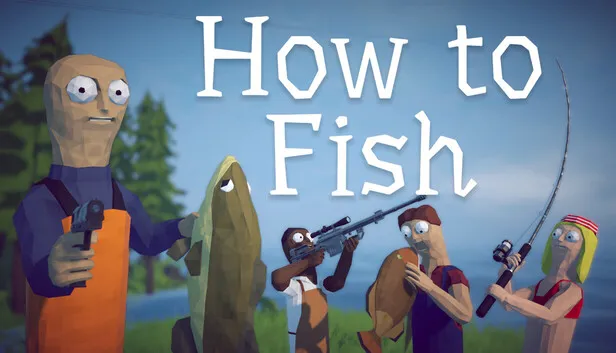
The cut Every measurement was taken on 24 August 2026 at 18:10 UTC, on the fourth day after launch. Storefront ranks are live and will certainly have moved by the time you read this. Figures about TikTok, the studio's history and the investment terms come from public write-ups and are flagged as such — we do not observe those platforms ourselves.
01The short version
On 20 August two Swedish programmers shipped a physics-based co-op fishing game for five dollars. The peak landed on day four — 341,691 concurrent players on 24 August at 14:25 UTC. Across five weeks of our observation only Counter-Strike 2, Dota 2, Palworld and PUBG have been higher.
Wishlists explain the start and nothing beyond it. The game came to 20 August ranked #174 in the global wishlist chart — about 292,000 wishlists on our calibration curve, in a range of 205,000 to 380,000. Day one delivered a peak of 33,231; after that concurrents grew tenfold, with no new wishlists left to draw on. What accounts for the rest is in sections 04 and 06.
The second concerns the week before release. On 13 August the studio put an exact release date into the store page, and that same day the game began gaining weight fast in Steam's recommendation graph and in the wishlist chart. Over the remaining week its share of new “More like this” links grew twenty-five-fold, before the game could be bought at all.
The third is the shape of the curve. Daily peaks run 33,231 → 129,217 → 261,378 → 341,691, and every night ends higher than the previous day. A game that only converts stored wishlists peaks in the first hours and decays from there. Here the maximum landed on day four, at the moment of the cut itself.
We take each of those three observations apart later in the issue, and each time we run into the same thing. The demand for this game was built over two years in a channel that almost nobody sees — the store page carries no link to it, the sales estimators do not read it, and the buyers do not name it.
02Who did this
Dazed Games is two people: Carl-Vilhelm Johansson and Melvin Olsson. They studied programming at the same Gothenburg school from 2017 and enrolled together on the game programme at the University of Skövde — as they describe in their incubator interview. The company was registered on 21 February 2024 in Mölndal, just outside Gothenburg.
Their previous game failed, and they have said so themselves. Out of Hand launched as a paid title in the summer of 2025 and did not sell. In an interview with their incubator five months before How to Fish shipped, Melvin Olsson gives the reason: “We released the game in the summer, but sales were very low. One of the reasons was that we weren't good at marketing.” Peak concurrents for Out of Hand: Deluxe were 20 players.
In August 2025 they dropped Out of Hand and started How to Fish with a different approach to promotion: a short clip showing a new feature, published during development. They call it “weekly”; the posting record says otherwise (section 03), but the principle of showing the game while you make it is what they described in that same interview, six months before release.
What Landfall provided The game's investor is Evil Landfall, the publishing arm of the studio behind Content Warning, Haste and, as co-author, PEAK. The stated model: up to a million dollars across a few games a year, project-based investment with no stake in the studio and no IP rights. The investor carried the financial risk of development. A publisher's work — PR agencies, key distribution, embargoes, coordination with creators — is not part of a deal like that. Steam lists Dazed Games itself as the publisher.
03Where the demand was built
The game had no publisher and none of a publisher's channels, so the demand was built somewhere else. The nearest observable trace is the wishlist chart. A month before launch the game sat at #272 there and barely moved: twelve positions in eighteen days. Then the rank started climbing three times faster.
The kink lands on the date announcement. Before 13 August the game moved 0.7 positions a day; after, 12.3. On our rank-to-count curve that is a move from roughly 195,000 to 292,000 wishlists, with ±30% of spread between games. Rank speaks to visibility, not to volume.
A contested number The wishlist count deserves to be shown as contested. Our curve gives ~292,000; the Raijin service independently estimates pre-launch demand at 90,000 on a falling curve since March. That is a 3.2× gap. We lean towards our own figure: its anchors are checked against real Steamworks panels, whereas Raijin's method is undisclosed and its revenue estimate is arithmetically impossible (see section 10). But if they are right, this issue's thesis only gets stronger: pre-launch demand would have been mediocre and declining, and the outcome still second in the genre's history.
The channels we do follow are small for this studio: as of late July the YouTube channel had 285 subscribers, Bluesky 30, X 172. None of them explains a tenth of the estimated 292,000 wishlists. TikTok and Instagram do. Everything that follows in this section is read off somebody else's counters, and part of what was previously thought about this channel had to be corrected.
How often the clips went out
In their incubator interview the studio describes the strategy as “a weekly video showing a new feature”. The posting record does not support that: 57 clips across twenty-one months is 2.7 a month, with gaps of 54, 61 and 54 days. Almost two months separate the clip of 17 November 2025 from the next one; two more separate 6 March from 7 May. The word “weekly” describes the studio's intention; the posting went out on a different schedule.
And the peak came not in the pre-launch months but in November 2025, nine months before release: the clip of 11 November drew 3.7 million views and 548,000 likes, the one of 17 November 4.5 million views. Everything since, the launch video included, is smaller. A week after those November clips, PC Gamer and GameDaily wrote about the game for the first time.
| Clip | Views | Likes |
|---|---|---|
| 17 Nov 2025 — trailer | 4.5M | 343k |
| 11 Nov 2025 — “added knife” | 3.7M | 548k |
| 7 May 2026 — new trailer | 2.9M | 392k |
| 20 Aug 2026 — launch clip | 1.9M | 174k |
| 21 May 2026 — sunfish boss | 1.5M | 180k |
The eighteen clips we could read metrics for account for 21.9 million views and 75.5% of the account's total likes. Extrapolated across all 57, that is roughly 27–29 million views lifetime. TikTok rounds views and likes; only saves and comments are exact.
The clip formula
The text laid over the video is nearly always the same: “added ⟨something⟩ to the fishing game”. Added a knife. Added dynamite. Added a pufferfish. Added a shotgun. Made a new character. Updated the boat.
One thing the formula leaves out: the game is never named on screen. It is “the fishing game”. Comments asking “what's it called?” ran from at least November to January, until the studio gave in and captioned a clip “game name how to fish btw stop asking pls 😭”. The rest of the format: median length 13 seconds, exactly five hashtags, someone else's trending audio in sixteen clips out of eighteen. Not one clip is flagged as an ad.
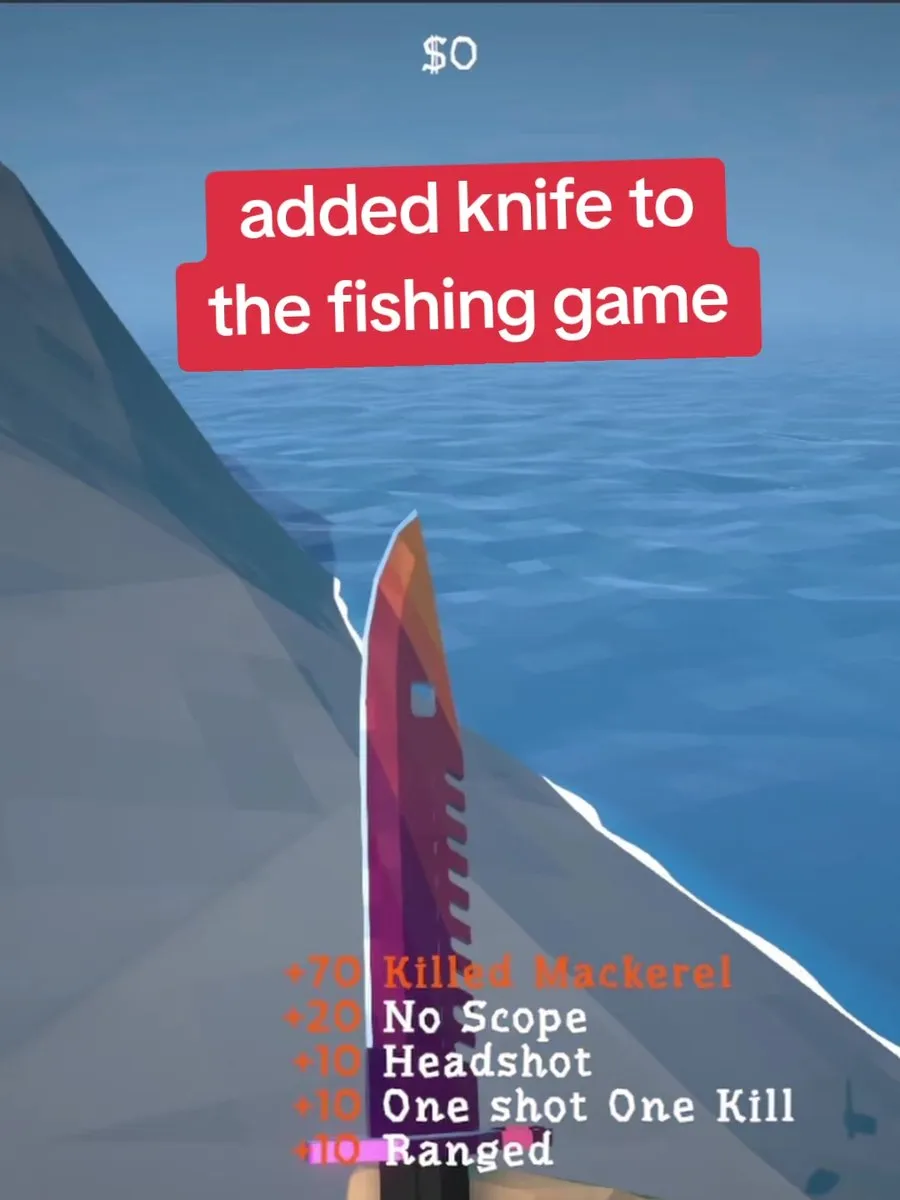
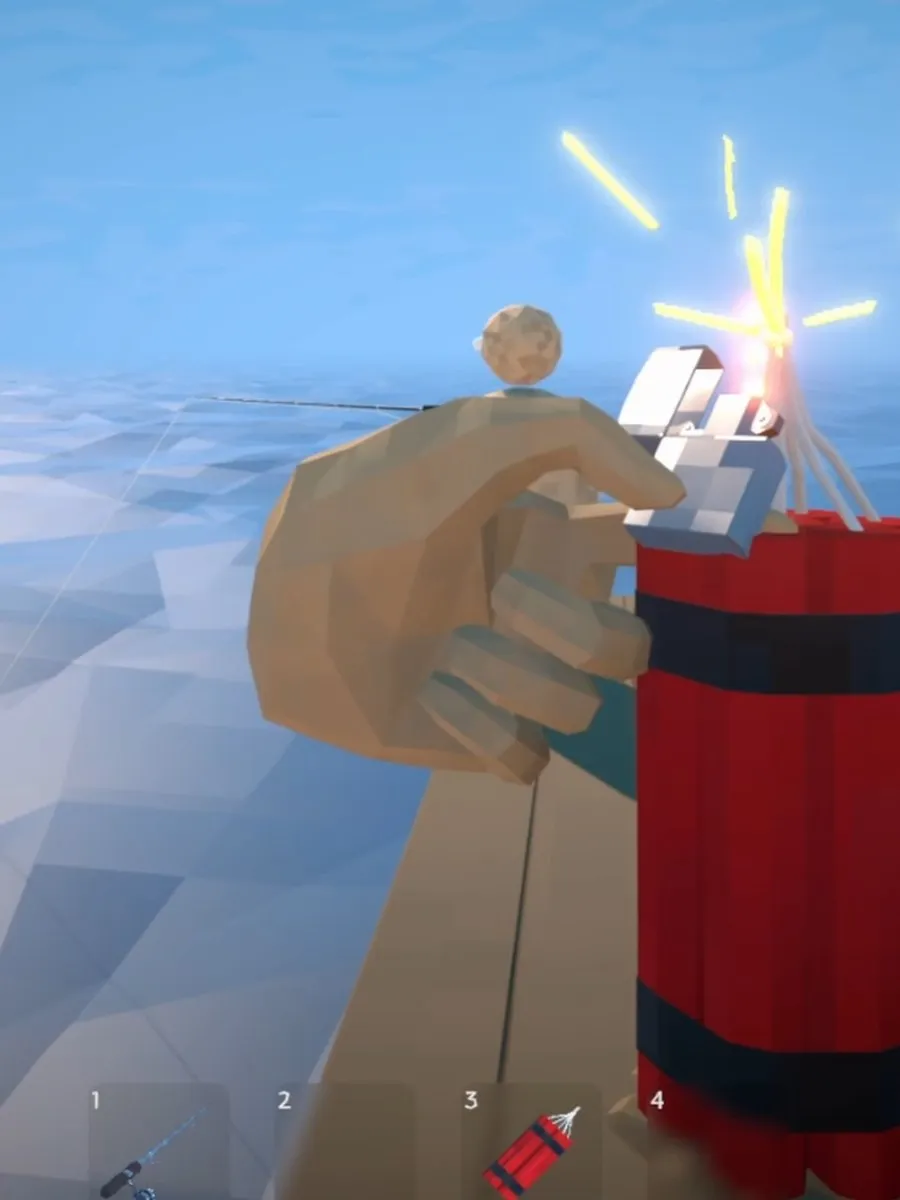
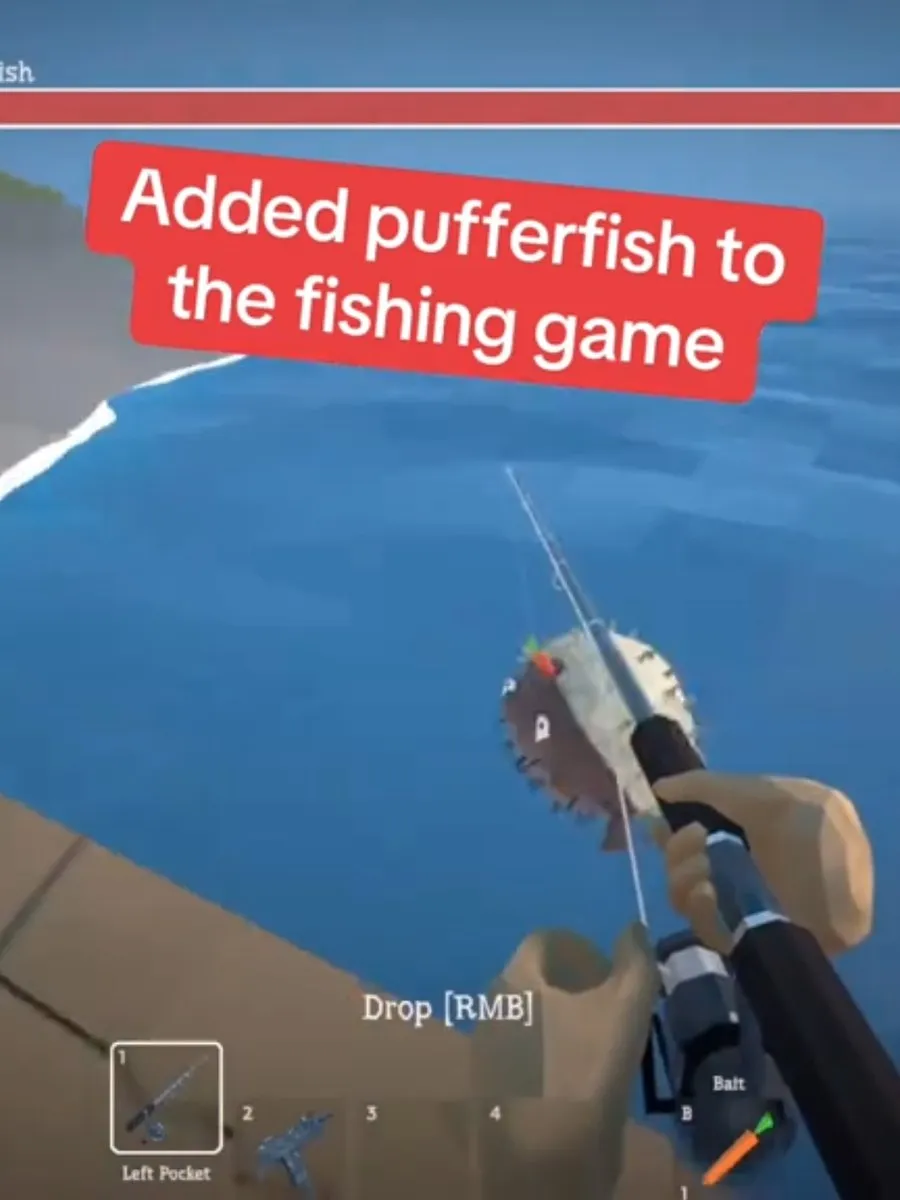

Cover frames from the studio's account. Two carry the caption in the frame itself; for the other two TikTok picked a still from mid-clip, though the on-screen text is the same.
Twice the studio addresses a specific audience on screen: on 12 June with “@ohnePixel added new feature to the fishing game for you” plus his hashtag, and on 17 August with #peak, a throw to the audience of their investor's game. Whether any arrangement sat behind either, we do not know: neither the streamer nor the studio has said anything publicly.
A second channel: Instagram
We had missed a second channel of the same size. The studio has 33.6k followers on Instagram, and the same clip is cross-posted there within the same minute. The launch Reel drew 1.44 million views against 1.9 million on TikTok — on half the audience. Across the twelve measured pairs Instagram averages a third of TikTok; at launch it delivered three quarters. The accurate phrasing is “a TikTok-and-Reels pair off one asset”, not “TikTok”.
Views did not become an audience 27–29 million lifetime views produced 68.6k followers — on the order of 0.25%. Even now, with three hundred thousand people playing, the account gains about 85 followers an hour. The recommendation feed delivers one-off impressions, and the subscriber base barely grows from them. A developer setting out to repeat the approach should count the reach of individual clips rather than the audience gathered.
| Channel | Before launch | At the cut | Growth |
|---|---|---|---|
| Steam followers | 9.7k | 28.3k | ×2.9 |
| Discord | 6.7k | 17.5k | ×2.6 |
| TikTok (external data, sampled 23 and 24 Aug) | ~66.9k | ~68.6k | ×1.03 in a day |
| Studio YouTube channel | 320 | 408 | ×1.3 |
The studio's own YouTube channel has 408 subscribers, and the launch trailer drew 23.8k views there. The same clip on TikTok drew 1.9 million — an eighty-fold gap on identical material.
It is clear why the format suited this game. The loop is to yank a fish into the air on a line and finish it mid-flight: knife, shotgun, sniper rifle, dynamite, bonus XP for a no-scope, plus a casino where you gamble the catch on slots. Every mechanic fits into a thirteen-second clip with a clear ending. The game and the content calendar were built on one schedule. Steam saw none of those clips: the store page carries no link to TikTok or Instagram, and the game's news feed is empty until release day. The one signal the platform got from the studio before launch was the date.
0413 August
On 13 August at 09:14 UTC the studio changed the store page's release date from “Q3 2026” to “20 August”. That same day the game began gaining weight fast in the “More like this” graph.
We walk that graph daily and count the links. The absolute number of new links depends on how many games we managed to look at, so the only comparable figure is a share: how many new links point at How to Fish out of every million new links that day. The denominator runs 1.6–2.9 million links a day.
The first twelve days of August hold a baseline of 25–60 ppm. 13 August: 197. 16 August: 826. Launch day: 1,022. After that 1,500–1,700. A twenty-five-fold rise happened before the game could be bought.
The practical takeaway is direct: an exact release date is for Steam's algorithms, not only for readers of news posts. How to Fish left seven days between announcement and launch, which is short by industry standards. The studio already had its wishlists and did not need to sell the date in advance.
05The minute of launch
We know the moment of launch to within a few minutes. The first concurrents sample is 14:12 UTC at 1,953 players; at a growth rate of about 150 players a minute that gives 14:00–14:05. The upper bound agrees: at 13:34 the game was still in the “Coming soon” block on the front page.
- ≈14:05 Launch. $7.99 with 38% off → $4.95 for a week
- 14:08:55 Landfall posts the clip on TikTok — 49 seconds ahead of the studio itself; on Instagram the gap is two minutes. The asset was with the investor in advance
- 14:09:44 The studio's own launch clip on TikTok — 1.9 million views; the same clip on Instagram will add another 1.44 million
- 14:12 First concurrents sample: 1,953; first buyer review
- 14:32 Steam announcement: “HOW TO FISH IS RELEASED”
- 14:33 First Steam storefronts: Top Sellers, New Releases, Specials. Concurrents already 5,186
- 15:33 The Steam front page. Concurrents already 9,787
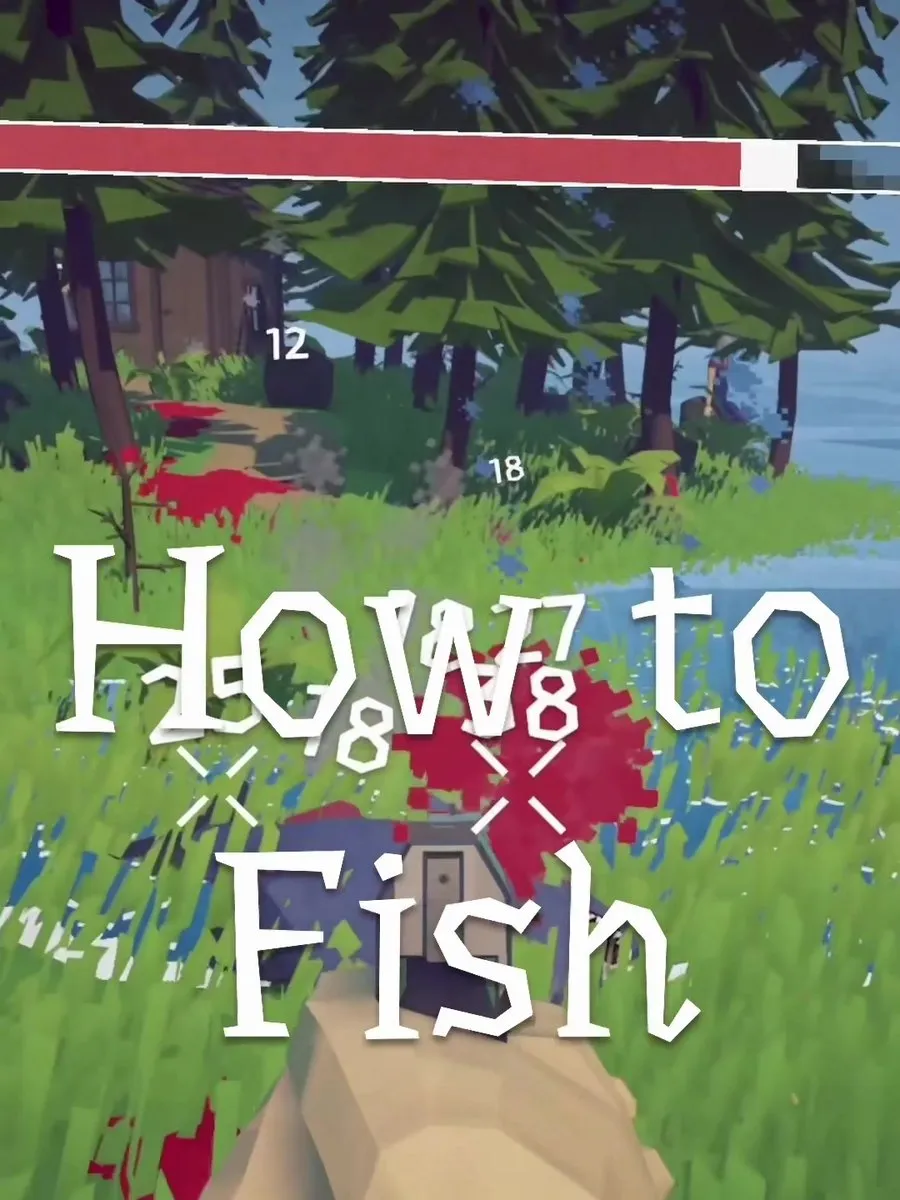
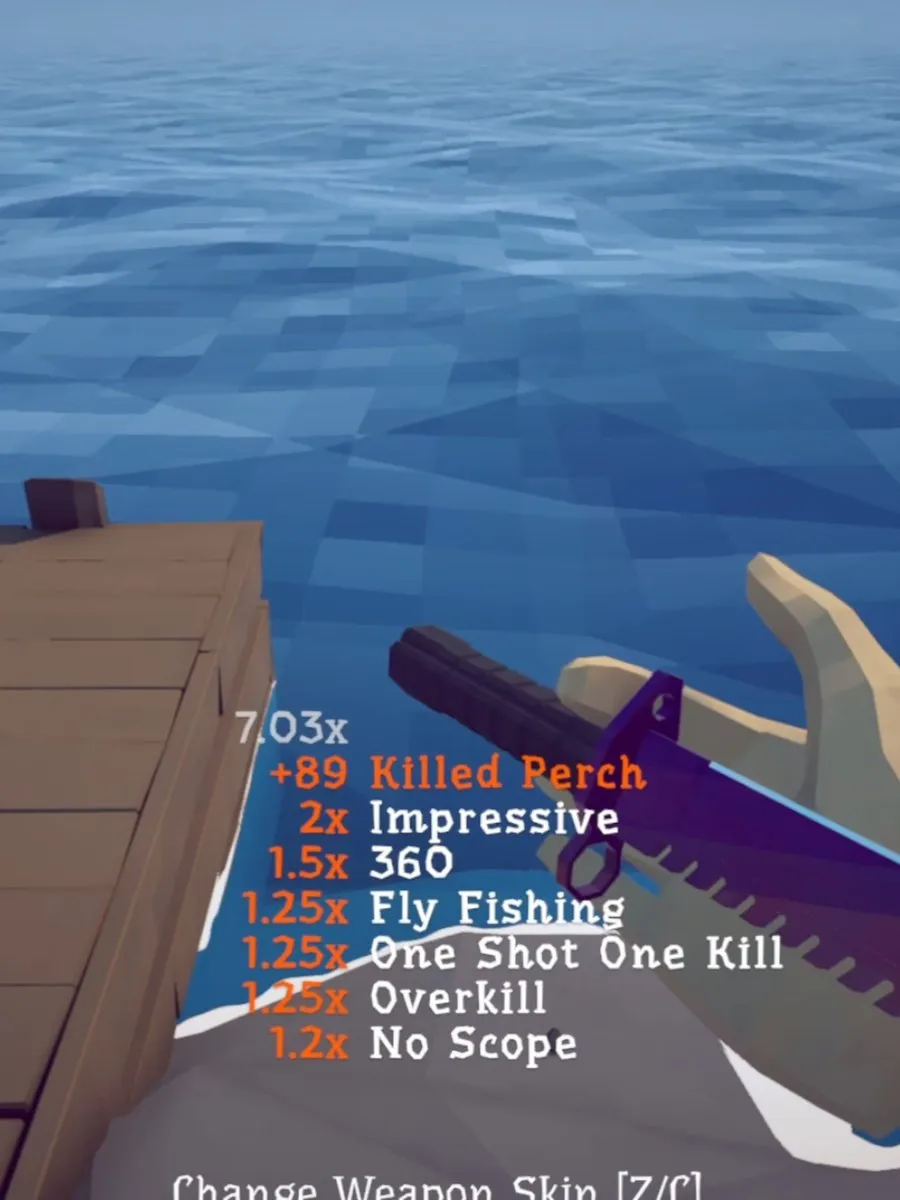
The ordering establishes one thing firmly: the first thousands of players did not come from Steam's storefronts, because there were none at that point. Where they did come from is a separate question with two plausible answers. One is the TikTok volley that matched the store page going live to within three minutes. The other, no less likely, is Steam's own automatic email: the store notifies everyone holding the game on a wishlist the moment it releases — about 292,000 people, plus 9,700 page followers. Our data cannot separate the two, and players almost never write down where they came from. Storefronts joined afterwards: by day four, with short-video organics running out, the front page across every country is the most visible channel left, though its contribution cannot be separated from word of mouth either. Neither candidate for those first thousands shows up directly in our series. Only the shape of the curve does.
06Four nights above the previous day
We sample concurrents 11–12 times an hour. Days here are counted from the hour of launch rather than by the calendar; otherwise day one would be a ten-hour stub.
Five waves, each higher than the last. Nightly troughs: 1,953 → 33,619 → 79,619 → 103,908, meaning every night ends above the previous day. The maximum — 341,691 — falls on hour ninety-six, and the curve has been sliding for four hours since. The verticals mark three of the five patches shipped; the other two were minor bugfixes.
| Day since launch | Peak | Trough | vs previous |
|---|---|---|---|
| 0 · 20–21 Aug | 33,231 | 1,953 | — |
| 1 · 21–22 Aug | 129,217 | 33,619 | ×3.89 |
| 2 · 22–23 Aug | 261,378 | 79,619 | ×2.02 |
| 3 · 23–24 Aug | 336,089 | 103,908 | ×1.29 |
| 4 · 24–25 Aug, partial | 341,691 | 165,018 | — |
The multiplier is falling — saturation is visible — but the sign never changed across four days. In issue two we looked at Servant of the Lake: there the peak arrived two and a half hours after launch and the curve only fell afterwards. Here it climbed for ninety-six hours. The launch maximum is 341,691, set at 14:25 on day four; whether the day itself closed there will only be clear on 25 August, with the evening still ahead.
The lobby cap The game shipped with four-player lobbies. Twenty-six hours later patch 1.0.4 raised the cap to eight and softened the bosses at the same time. For a game people enter as a group, that doubles the size of the inviting party. We cannot size the effect honestly: a bundle, a discount and five storefront events sit next to it in time. But a two-person team removed the ceiling within a day and shipped five patches in four.
07What Valve gave
Storefronts are the one part of this launch we observe end to end. The package here is the fullest we have seen, and at the cut it is still holding.
| Surface | Best rank | Countries | Status at the cut |
|---|---|---|---|
| Top Sellers | 1 | 41 | live · #1 in 33 countries |
| Front page: Featured & Recommended | 1 | 41 | live |
| Front page: top sellers and specials | 1 | 41 | live |
| Tag charts: Action / Adventure / Indie / Shooter | 1 | 41 | live |
| Specials chart | 1 | 41 | live |
| Global daily-active-users chart | 6 | — | live, holding sixth |
| New Releases | 3 | 41 | gone 21 Aug |
| Popular Upcoming | 1 | 41 | gone at launch |
A large share of that package follows from the studio's own decisions rather than from any special favour.
Tag charts. The game landed in the charts of tags it already had. The stray Sexual Content tag was removed on 6 August, two weeks before launch; the current set — Multiplayer, Online Co-Op, Fishing — settled on 15 August, five days out, and after launch only reshuffled within the top few.
First place in the specials chart follows directly from the 38% launch discount.
Localisation was also done in advance. On 3 August the store page went from one language to sixteen, all with full voice-over, and picked up 28 achievements and full controller support at the same time. Three weeks later Simplified Chinese would be the second-largest language in the review corpus, at 11.7%.
08Reviews: thirty characters
At the cut the game has 15,658 reviews, 94.3% positive. We read the texts almost up to the cut itself: 15,535 reviews, 99% of the counter, the last one forty minutes before the mark. Everything below about their content is computed from those.
Playtime at the moment of review rises (2.95 → 5.25 hours) while review length falls (39.5 → 22 characters). People play longer and write less. The last day is incomplete.
The bar for speaking up is low: a short review works as a way to join the joke, and for every “helpful” vote there are 0.32 “funny” ones. Where the players came from cannot be reconstructed from the reviews: the word “tiktok” appears eight times across 15,535 of them. We come back to that observation in section 11.
The negatives have two addresses. The first is online safety: the most helpful negative review is entirely about it, and the second is about a player joining someone else's lobby and wrecking the session. This is not a hack in any strict sense: no technical writeup, no numbered vulnerability and no researcher's post exists. It is a Steam matchmaking lobby visible more widely than the developer assumed, plus a separate bug letting a joiner end someone else's game instantly. The studio answered within a day — invite-only lobbies and a block on that instant ending — and the author of that top review later added that the developers reached out and fixed it. One caveat: the private lobby remained an option, not the default.
This story is now on its third repeat. WEBFISHING went through it in November 2024, PEAK in 2025, How to Fish in August 2026: one class of problem at three different studios on one platform wrapper. The cause is not inexperience but a Steam default that everyone in this genre walks into. For a launch that lives on word of mouth the cost is high: a broken session means four people who will not invite a fifth.
The second address is difficulty, and almost entirely in the Chinese segment. Simplified Chinese sits at 87.6% positive against 94–96% for the other large languages, on a 14.9% share of the corpus. The complaints are uniform: bosses hit far too hard, the character has no health upgrade, playing alone is unbearable.
Two things change how that number should be read. First, the cumulative figure is a scar from a single day. Day by day the Chinese positive share ran 91.7% (20 Aug) → 77.3% (21 Aug) → 86.2% → 87.1% → 90.0% (24 Aug), while English held 94–97% over the same days. The dip happened on 21 August, the segment has since returned to ninety per cent, and the lifetime number drags the old day along.
Second, these are not first-hour refunders. Median playtime at the moment of a negative review is 252 minutes for the Chinese segment against 146 for English — nearly twice as long. These people cleared three or four islands, hit a boss and only then voted down. The bad-localisation hypothesis can be closed: Traditional Chinese scores higher than Simplified, and a translation problem would have sunk both. The community answered in its own way: within three days Bilibili filled with trainer videos selling infinite health and a defence multiplier. Cheats are doing the job of the difficulty setting the game does not have.
09Where it sits among releases
The scale of this launch is easiest to see against its neighbours in the calendar. 20 August also saw Mortal Shell II, a game of an entirely different budget. Over a common 48-hour window from each game's own start How to Fish reached 130,738 and Mortal Shell II 39,116 — 3.3 times smaller; on full maximum the gap is sevenfold. The median for the day excluding How to Fish is around 400 players.
This is not “the fifth biggest game on Steam ever”: games whose records were set in earlier years appear here at their current level. Read it this way — across five weeks of observation only four Steam games were ever online in greater numbers than How to Fish on its fourth day.
For comparison, PEAK, the investor's own game and the one that set the template for this niche, holds 122,714 in the same window. Content Warning holds 4,025. The cross-bundle neighbours, Gamble With Your Friends and Sledding Game, hold 9,255 and 214. Across a month of observation this is the largest launch on the platform; the closest over the first 48 hours was a free Call of Duty beta.
10What it is worth
We do not observe sales. Below are four ways of approaching them from the outside, and what matters in this section is not any single answer but how far apart they land.
One: from reviews
Our model relates accumulated reviews to units: a median multiplier of 43–46 and a conformal interval of ×0.46 … ×1.87 at a stated coverage of 80%. On a counter of 15,658 that gives about 700,000 copies, with a range from 320,000 to 1.30 million.
That is the figure we would have printed as the answer, but for three things. First, the multiplier is calibrated on lifetime labels and we are applying it on day four, when reviews trail purchases — the median author writes after five hours of play. Second, in four-player co-op one review covers a group rather than a copy, and the 52-game corpus behind the model holds few games like that. The third is below.
Two: position in Top Sellers
The Top Sellers chart ranks by gross revenue, not by units. How to Fish first touched first place on 23 August at 06:35 UTC, has held it steadily since 21:35 that day, and sits first at the cut — above Counter-Strike 2, Dota 2 and Apex Legends, that is, above games that live on in-game purchases.
For a five-dollar game to out-earn those on a daily basis takes volume. Our rank calibration, position to revenue per day, puts first place at around 5 million dollars a day. Along the actual path — #38→#7 on day one, #3–4 on the 22nd, first place from the 23rd — four days come to roughly $11 million gross, which at $4.18 per copy is about 2.6 million copies. Four times what the review model gives.
That number cannot be used directly: the calibration is marked experimental, its first-place anchor is a floor with no ceiling, and the geography of the original scale is unstated. But the direction in which it disagrees with the review model matters more than its magnitude.
Three: what the studio and the estimators say
On 23 August the studio announced a million “fishermen”. Those are a developer's words, not a panel export: the figure is rounded up, and “fishermen” means players rather than copies sold. The studio handed out no keys at all, so the 11.1% of reviews that are not from Steam purchasers is almost certainly family sharing. The gap between “players” and “copies” is built into the game itself: part of that million was playing on someone else's purchase.
Third-party services go higher still: Video Game Insights says 1.70 million copies and $6.8 million, Gamalytic 1.80 million and $7.8 million. They do not inspire much confidence, though. Gamalytic claims 2 million players — more than the studio itself announced a day earlier. And Raijin's $3.12 million across 459,000 copies works out to $6.80 per copy, above the game's maximum price in any region under a discount that ran from the first minute. No such copy exists: their numbers come from different models and were never reconciled. SteamSpy had not indexed the game at all four days in.
What follows from this
| Method | Copies | Gross revenue |
|---|---|---|
| Review model | 0.70M | $2.7–2.9M |
| Studio's own claim, 23 Aug | ≥ 1M players | — |
| Video Game Insights | 1.70M | $6.8M |
| Gamalytic | 1.80M | $7.8M |
| Top Sellers rank model | ≈ 2.6M | ≈ $11M |
| Our judgement across all four | 1.0–1.8M | $3.9–7.5M |
Four independent methods spread by a factor of 3.7, and three of the four sit above our review model. None sits below it. So 700,000 copies reads as a floor rather than a centre, and the working range is one to 1.8 million, where the studio's claim and both third-party estimates overlap. At that volume the studio keeps roughly $2.5–4.5 million after deductions.
The bottom row of the table is a judgement, not a calculation: we drop the extremes at both ends. The precision is illusory — any of these methods could be out by a factor of two, and the only thing that would settle it is a Steamworks panel we do not have. The per-copy figure is computed from real regional prices read across fourteen countries: $4.95 in the US, ¥20.46 in China, ₽222 in Russia, $2.47 in Türkiye, €4.64 in Germany. Weighted by the language mix of reviews it comes to $4.18 with tax and $3.87 without; roughly 34% of the audience sits in cheap regions. One bias remains: the language of a review is not the country of purchase. Refunds are not estimated separately; after Steam's cut and a typical refund rate the studio keeps around $2.50 per copy. The money in this launch is observed about as poorly as the channel that made it.
11What the launch was made of
None of the five elements below is rare on its own. They coincided in time, and that is the only thing separating this story from a dozen similar ones.
- 1 Two years of short clips. 57 clips across twenty-one months, 2.7 a month, with two-month pauses. Reach peaked in November 2025, nine months before release. The game was built so that every mechanic fits into thirteen seconds.
- 2 Cheap co-op that people enter as a group. For one person to play, three to seven copies must be sold. At five dollars, inviting a friend costs almost nothing — and that, not TikTok, is what players themselves name as the main reason (see below).
- 3 An exact date a week out. On 13 August the game's weight in the recommendation graph tripled in a day and grew twenty-five-fold over the week — before launch.
- 4 A coordinated volley in the minute the page went live. The investor posted before the studio itself — by 49 seconds on TikTok and two minutes on Instagram. So the asset was with them in advance, and this was an agreed cross-post rather than a spontaneous reaction.
- 5 Five patches in four days. The lobby ceiling removed in 26 hours, the griefing problem closed in 49.
What the investor's boost was worth in reach Landfall's repost across both platforms drew 560,000 views against 3.34 million for the studio's own — about 17% on top. It is their only post about the game: neither before launch nor after, the million-player day included, did Landfall write anything else, and on 24 August they were promoting a different title. The investor's money was decisive; the public boost was not.
What this explanation does not contain:
- A demo. There was none, and the game did not take part in Next Fest. The standard “ship a demo” advice was not followed.
- Keys for press and streamers. Not “we found no trace” — the studio states it outright in its own FAQ: “Sorry we are not handing out free game keys to anyone.” The only real review in the world is marked “personal purchase”. Monetising videos, by contrast, is explicitly allowed.
- Any pre-launch work on Steam. Zero posts in the game's news feed before release day. TikTok and Instagram — the channels that did the work — are not even linked from the store page.
- A publisher. Landfall provided money and one repost. By their own publishing lead's account, external projects get “the money (and a bit of advice)”; marketing and community management go only to Landfall's own titles.
- A long announcement runway. A week between date and launch, against the usual advice to announce months ahead.
- Flawless execution. 87.6% positive in the second-largest language segment, a live online-safety problem, 2% of reviews about bugs and crashes.
The people who bought it explain the success differently
This deserves its own space, because it contradicts our own reconstruction. Across the two main discussion threads on Reddit — around 320 comments — TikTok is not mentioned once. The consensus there is price. The phrasing that recurs in different forms: all it takes is a five-dollar tag and a friend on Discord saying “let's play this”, and four copies are sold on the spot. Eurogamer names the same cause.
That gap is itself a finding: the channel that built the demand was invisible to the people who made it up. Someone who saw a clip nine months ago does not connect the purchase to it and explains it by the price at the moment of deciding. For a developer this means that asking your own players “where did you hear about us” systematically under-counts the top of the funnel. Nothing else that measures a launch sees this channel either: the store page does not link to it, and the public sales estimators disagree with each other by a factor of four.
12How we will check ourselves
The forecast is frozen at 24 August 2026, 18:10 UTC, on day four. It can only be checked against points after that mark.
The cohort we lean on Five comparable co-op hits and their road to a peak: Lethal Company — 41 days, R.E.P.O. — 25, WEBFISHING — 27, PEAK — 62, Content Warning — 1 (and only because it was free for its first day). The median is 27 days. Against that, a peak on day four would be an anomaly, and the forecast below takes it into account. The cohort's second lesson: first-week retention predicts nothing (a 17–91% spread), while on day ninety three unrelated games converge on a narrow 13.9–17.9% of peak. After that only the cadence of content updates matters: without them a year later leaves 1–2%, with them 12% and 44%.
- The day-four peak — already settled. We bet that the day from 24 Aug 14:05 to 25 Aug 14:05 would top 336,089, against a naive benchmark of exactly 336,089. Twenty minutes after the freeze concurrents reached 341,691 and then fell away. The call was right, with a caveat: the margin was 1.7%, which is persistence rather than a clear win over it. The day itself only closes on 25 August.
- When it turns down — and here we disagree with the cohort. The multiplier between daily peaks decays close to geometrically (3.89 → 2.02 → 1.29), and continuing the series crosses one on day five or six. The cohort median says day 27. We back our own series rather than the cohort, because How to Fish has risen continuously from hour one, whereas the late peaks of Lethal Company and PEAK were second peaks driven by updates and holidays. If the cohort turns out to be right and our own series wrong, we count that as a miss.
- The end of the discount — 27 August, date confirmed. The store page reads “INTRODUCTORY OFFER! Offer ends August 27”, and it is an introductory discount: Steam's rules bar another promotion for thirty days after one. So the price rises 61% and stays there until late September. We predict that within two days of it lifting the game loses first place in Top Sellers. Leaving the specials chart does not count; that is mechanical. It also makes a natural experiment in demand elasticity for a cheap co-op game at peak attention.
- The positive share of reviews. By 31 August it will slide into 92–94%: it fell every single day across sampled days (96.8 → 94.5 → 93.7 → 93.2), and a widening audience usually continues that trend. We do not forecast the review count itself — it depends on where the peak falls.
- Retention on 31 August. No numbers: the cohort's first-week band is 17–91%, and it is set by how the peak was taken rather than by quality. Qualitatively we predict How to Fish lands nearer the top of that band, like R.E.P.O. at 91%, rather than the bottom, like Content Warning at 17%: first-week collapses happen to games whose peak was inflated by a giveaway, and this curve grew organically.
- Day ninety is the strictest test. On 19 November 2026 concurrents will be 14–18% of peak. That is the tightest band anywhere in the cohort data and the one place where three unrelated games agree.
- The Chinese segment. It will remain the weakest of the top five languages by rating — below 92% positive cumulatively on 31 August — even though the daily rate has already recovered to 86–90%. One caveat: the studio patches daily and could refute this deliberately; if it does, we still count the miss.
13Limitations
- We do not observe the main channel. TikTok and Instagram are outside our view, and every figure about them is someone else's. We cannot tell “TikTok drove the demand” apart from “demand and TikTok both grew from a common cause”.
- Review texts lag the counter by a day. Composition, playtime and themes describe the first seventy-four hours; anything that appeared on 24 August is under-represented in them.
- The geography of purchases is known only indirectly. We read regional prices across fourteen countries, but weight them by the language of reviews, and language is not the country of purchase. How far that shifts the per-copy figure, and in which direction, we do not know.
- The peak has not been passed. Everything said about the shape of the curve is provisional. We did not compare the decay against a cohort: for a rising curve the share of its own maximum is not yet defined.
- Launch events are inseparable. Release, discount, three bundles, five storefront events and two patches all fell within four days. Every “X caused Y” in section 11 is a hypothesis with checkable timing, not a measured effect.
- The million players is someone else's figure. It is a developer post; it cannot be verified independently and is not built into the copy estimate.
Disclaimer. The material on this page is informational and research-oriented. These are observations from open sources and estimates based on them: samples are small, the method is imperfect, calculations are approximate, and forecasts and interpretations may turn out to be wrong. We do not observe sales or revenue; the calculation in section 10 rests on a model and an assumption about price. Nothing here is business, financial or investment advice; any decisions you make on the basis of this material are made at your own risk.
Observations: Steam storefronts across 41 countries, concurrent players, the wishlist and daily-active-users charts, reviews, the recommendation graph, community followers and Discord. Data cut — 24 August 2026, 18:10 UTC; storefront ranks are live and will certainly have moved by the time you read this. The comparison set covers 22 releases from 20 August, every release between 20 July and 22 August with non-zero concurrents, and five co-op hits of earlier waves — Lethal Company, Content Warning, WEBFISHING, R.E.P.O. and PEAK — from their public concurrency curves. TikTok and Instagram metrics, the studio's history, the investment terms, third-party sales estimates and the press survey come from open sources: the Sweden Game Arena interview, PC Gamer's report on Evil Landfall, the public @dazed_games accounts on TikTok and Instagram, the FAQ on the studio's site, and the sales estimators Gamalytic, Video Game Insights and Raijin; we cannot verify them independently, and section 10 shows how far apart they are. The game's page — How to Fish on Steam. Previous issues: Static Dread, Servant of the Lake, The Sorting Bureau.
The researches and datasets behind this issue were prepared on the PlayRecon v0.3 platform.
Figures from the studio's own posts and from third-party publications are cited with a link to the original and remain the property of their authors. If you quote or use this breakdown, please link back to the original.